



If you are reading this, you’re probably experiencing ongoing stress, anxiety, overwhelm, or burnout. These days, what adult hasn’t dealt with these issues? We are here to share information, support, and complementary care suggestions to help you reduce stress and anxiety, so you don’t fall into overwhelm or burnout. And if you’re already in overwhelm and feeling burnt out, we can help with that, too.
Here’s what you will learn:
Note: If you’re feeling stressed right now, we don’t want to stress you out any further. Skip the nitty-gritty signs and jump straight to the evidence-based tools and guided programs.
When the nervous system perceives a threat, whether physical, emotional, or psychological, it activates stress responses designed to protect us. This hard-wiring has been with us since the beginning of time. You might experience an increased heart rate, a sharper focus, and a surge of energy, preparing the body to respond quickly. These responses are meant to help us survive immediate danger and are needed for short-term challenges.
When the nervous system shifts into a safe state, it signals the body to restore and balance. Heart rate slows, digestion improves, muscles relax, and the brain becomes better able to learn, regulate emotions, and form social connections. In this state, the body can repair itself, conserve energy, and build resilience.
Unfortunately, modern life often exposes us to chronic stressors, deadlines, financial pressure, social tension, and constant stimulation that repeatedly activate a survival response even when no immediate danger is present. If this happens too often, it can disrupt the nervous system’s ability to accurately distinguish between threat and safety, leading to persistent tension, anxiety, fatigue, and difficulty relaxing. Lions, tigers, and teddy bears? Oh my!
Since the nervous system’s role is not to eliminate stress, but to adapt fluidly, moving efficiently between states of activation and rest, what do we do with all of that stress? More on that later.
Healthy nervous system regulation is the first step in responding to challenges when needed and returning to a state of calm and stability once the threat has passed. Let’s take a look at the finer points of the nervous system.
The autonomic nervous system (ANS) is the part of your nervous system that operates in the background, automatically managing essential functions that keep you alive and feeling balanced, without you having to think about them.
ANS controls things like:
The autonomic nervous system constantly adjusts these functions based on what’s happening inside your body and in your environment. Its main job is to help you respond to challenges and then return to a balanced state.
It has two primary functions that work together:
In a healthy nervous system, these two functions fluctuate between activation and relaxation. You speed up when life demands it, then settle back into calm once the situation passes. When you experience stress over long periods, this balance can be disrupted, leaving the body stuck in a state of tension, fatigue, or both.
Simply put, the autonomic nervous system is your body’s automatic stress and recovery system, constantly working to keep you safe, stable, and resilient.
To make things clearer, let’s name these two branches of the autonomic nervous system.
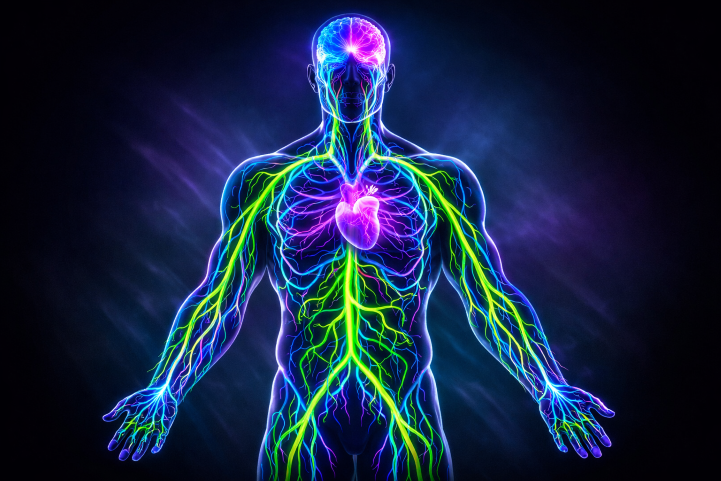
We already know that the autonomic nervous system has two main branches that work together to help you respond to life. These two branches are called the sympathetic and parasympathetic nervous systems. It’s important to know that neither is “good” nor “bad”, both are essential for health and survival.
The sympathetic nervous system is the one that activates when your body perceives a threat or needs to take action. Its job is to help you respond quickly and effectively.
When this system is active:
This response is designed for short-term survival, helping you meet deadlines, react to danger, or perform under pressure. All of these, in the right measure, are essential. Problems arise when the sympathetic system stays switched on for too long due to chronic stress, leading to anxiety, irritability, exhaustion, and sleep difficulties, just to name a few of the impactful symptoms.
The parasympathetic nervous system supports recovery, healing, and long-term resilience. It becomes more active when the body perceives safety.
When this system is dominant:
This state allows the body to repair itself, restore energy, and build resilience for future stress.
Reducing stress isn’t about staying in the parasympathetic mode all the time; it’s about balance and flexibility. A well-regulated nervous system can activate the sympathetic response when needed and then smoothly return to parasympathetic calm once the challenge passes. Learning to regulate the nervous system helps strengthen this natural rhythm, making stress easier to manage and recovery more reliable. After all, stress is a natural part of life, and it is impossible to completely eliminate it.
Most of the signs of chronic stress and nervous system dysregulation are easily recognized. But what about the long-term effects? In case chronic stress has blurred your ability to perceive itself, we’ll also outline in detail the long-term consequences here.
Physical signs of nervous system dysregulation include: fatigue, tension, digestive issues, sleep disruption, and headaches.
Nervous system dysregulation in the form of emotional and cognitive symptoms includes: irritability, anxiety, brain fog, and emotional reactivity.
When the nervous system stays stuck in survival mode, it is literally biologically costly, often quietly at first, then more aggressively.
Stress hormones like cortisol and adrenaline make the heart work harder than it’s meant to.
A dysregulated nervous system confuses the immune system, leaving it either underactive or attacking the body itself.
Chronic stress alters how the body processes energy and regulates hormones, often permanently if unaddressed.
Prolonged cortisol exposure is toxic to the brain, particularly areas responsible for clarity and emotional balance.
What starts as “just stress” can harden into persistent mental health conditions, often requiring extensive time and effort to reverse.
The gut is directly wired to the nervous system. When stress is constant, digestion suffers, sometimes despite medical interventions.