


If you’re reading this after midnight, you’re not alone. The tired-but-wired cycle is one of the most common experiences in modern life and one of the least understood. New research explains what's really happening. And why the advice you've been given hasn't worked.
Maria is a nurse manager at a busy urban hospital. By the time she gets home at 7 pm, she can barely finish a sentence. She eats standing at the kitchen counter, sits down to watch something, and falls asleep on the couch by 8:30.
Then her alarm goes off at 11 pm, the one she set to remind herself to actually go to bed, and she lies awake until 2 am.
Her mind, she says, "just switches on." The staffing issue she didn't resolve. The patient from yesterday, she's still thinking about. The ten emails she'll wake up to. By 2 a.m., she's doing the math on how much sleep she'll get if she falls asleep right now. Which she doesn't. So now it's less.
Maria doesn't think she has insomnia. She thinks she's just bad at sleeping. If that sounds familiar, it’s because millions of exhausted people are experiencing the same pattern every night.
She's wrong on both counts.
She's not bad at sleep. Her nervous system never received the signal that the day was over.
Maria's experience has a name in sleep science: hyperarousal. And researchers now understand it well enough to know that it's not a character flaw, not a discipline problem, and not something you can fix by putting your phone across the room. It's a physiological state- one that millions of people are living in, quietly, every night- and it has a biological mechanism, and increasingly, a biological solution.
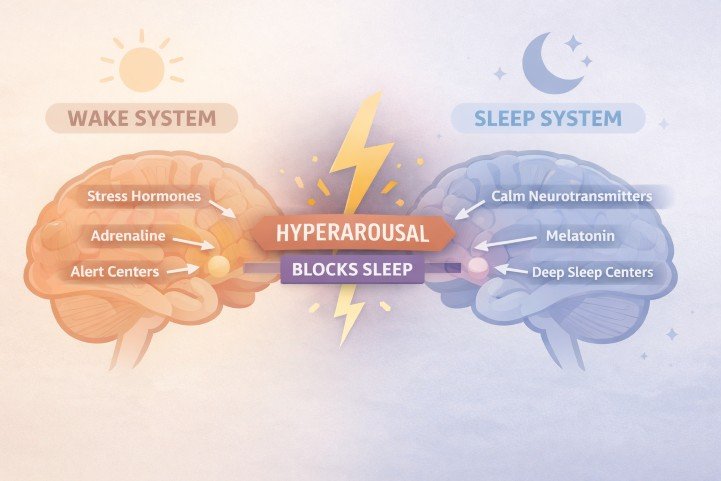
Many people who think they have insomnia are actually experiencing nervous system hyperarousal, a state where the body’s stress system remains activated even when you’re exhausted. Instead of shifting smoothly into sleep mode, the brain stays alert, scanning for unresolved problems or emotional stress. Researchers now understand that this “tired but wired” pattern is not due to a lack of willpower or poor sleep discipline. It’s a physiological state in which the nervous system never receives the signal that it’s safe to power down.
Common signs of the tired-but-wired cycle include:
Most people think of sleep and wakefulness as two ends of a single dial, and they assume that being exhausted enough will eventually push the dial toward sleep. This is not how the brain works.
Sleep and wakefulness are governed by two separate, competing systems. One promotes wakefulness, driven by neural circuits involving the hypothalamus, locus coeruleus, and orexin pathways. The other promotes sleep. In a healthy cycle, they hand off cleanly: wakefulness fades, the sleep system takes over, and you're out within minutes.
But when you're under sustained pressure, the relentless, low-grade kind that doesn't have a clear endpoint, the wake-promoting system stays activated. Not because you're doing anything wrong. Because it's doing its job. It's reading the environment and saying: things are unresolved. Stay ready.
A 2025 study published in the Journal of Sleep Research, analyzing sleep architecture data from more than 3,100 participants, confirmed that people with insomnia show continuous hyperarousal even during sleep itself, their brains exhibiting wake-like electrical activity across sleep stages, less efficient transitions between states, and disrupted sleep spindles, which are the neural signatures of stable, restorative rest.
In other words, for the hyperaroused sleeper, the brain isn't just slow to fall asleep. It keeps waking itself up from the inside.
A related finding from the Proceedings of the National Academy of Sciences goes further: researchers found that what perpetuates hyperarousal isn't just stress, but the unresolved emotional residue of stress. During healthy REM sleep, the brain processes and neutralizes the emotional charge of difficult experiences, essentially digesting the day. When REM sleep is fragmented or restless, that emotional processing is interrupted, and distress accumulates night over night, raising the arousal baseline a little higher each time.
This is why one bad week can turn into months of difficult sleep. The system isn't broken. It's overwhelmed and stuck in a loop.
For Maria, the sleep deprivation had become invisible to her because it had become constant. She stopped noticing how depleted she was because being depleted was normal.
She describes the effects now, looking back, as a kind of shrinking. "I stopped being creative. I'd go into meetings, and I could follow the conversation, but I couldn't generate anything. I had less patience. I was more impatient." She pauses. "I wasn't the caregiver I wanted to be."
This is the insidious mathematics of the tired-but-wired cycle: you adapt to it just enough to keep functioning, and in doing so, you stop recognizing the gap between how you're operating and how you could be.
The research is unambiguous about the costs of chronic sleep disruption. Decision quality drops. Emotional reactivity rises. Creative capacity narrows. The ability to sustain empathy, the thing that makes doctors good doctors, teachers good teachers, parents present parents, quietly erodes.
In healthcare settings, the consequences ripple outward: higher risk of errors, faster burnout, poorer team cohesion. In workplaces, depleted employees make worse decisions and leave sooner. On university campuses, students carrying sleep debt don't look like they're struggling; they look like they're managing, right up until they aren't.
What most of these people have in common is this: they're living in a body that knows how to be exhausted, but was never taught how to stop.
Sleep hygiene recommendations are not wrong. Consistent sleep timing, reduced screen exposure, and limiting caffeine - these are genuinely useful at the margins. But they address behavior. And the tired-but-wired pattern is not primarily a behavior problem. It's a physiological one.
You cannot think your way to a downregulated nervous system any more than you can think your way to a slower heartbeat. The hyperaroused state has its own momentum, and information, however well-intentioned, cannot interrupt it. What can interrupt it is something that speaks directly to the autonomic nervous system: specifically, breath.
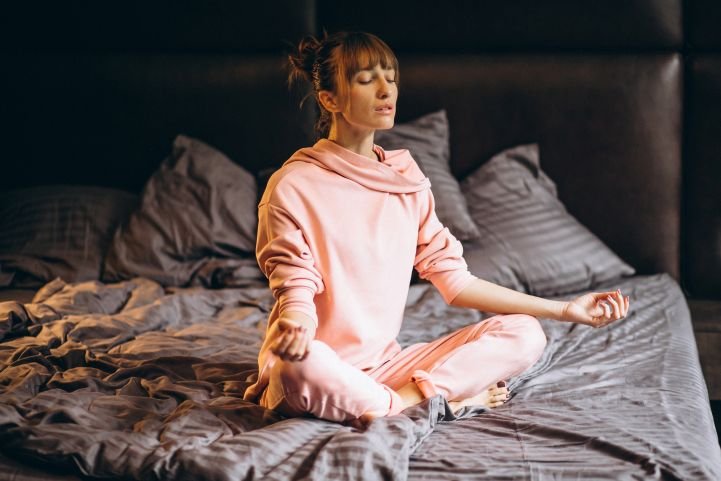
Slow, paced breathing directly activates the vagus nerve, the long, wandering nerve that connects the brainstem to the heart, lungs, and gut, and serves as the primary pathway for the parasympathetic "rest and recover" signal. When you breathe slowly and rhythmically, you are not metaphorically relaxing. You are generating a measurable shift in autonomic tone, one that the body's stress systems actually respond to.
A 2024 randomized clinical trial published in JAMA Network Open found that vagus nerve stimulation significantly reduced insomnia severity and improved global sleep quality compared to the placebo group, with effects maintained through 20 weeks of follow-up. Breathwork activates the vagus nerve through the same pathway. A study in Scientific Reports found that a single session of slow, deep breathing produced meaningful increases in vagal tone, with the effect actually stronger in older participants.
Breathwork-based approaches work through this same mechanism. They're not relaxation as a concept. They are nervous system regulation as a skill, repeatable, learnable, and available to you at 2 am in the dark when nothing else is working.
The goal isn't to try harder to sleep. It's to give your nervous system a signal it actually recognizes as safety.
This is the distinction that changes things for most people. Sleep isn't something you do. It's something your nervous system does when the conditions are right. The practice is learning to create those conditions, not by force, but by signal.
If you want to experience what this nervous system shift actually feels like, a free guided deep rest session is being offered during National Sleep Awareness Week. You can join here.

Maria started learning breathwork as part of a structured program focused on sleep and nervous system regulation. She was skeptical. She had tried meditation apps. She had read about sleep hygiene. None of it had touched the 2 am wake-ups.
What was different, she says, was the experience of actually feeling her system shift. "It wasn't a concept. It was something that happened in my body while I was doing it." The first time she made it through a full guided deep rest session, she fell asleep before it ended.
It took several weeks of practice for the changes to become consistent. Sleep onset became shorter. The 2 am wake-ups became less frequent, and when they happened, she had something to do with them, a specific breathing practice she could turn to instead of lying there calculating the hours.
"I feel like I got access to a part of myself I'd lost," she says. "More patient. More present. I'm a better nurse."
She still has hard weeks. The system isn't immune to pressure. But the baseline shifted, and more importantly, she has a path back when it slips.
Maria tells the story of the first night she slept through without waking. She didn't notice it had happened until morning, which is how it should be, unremarkable, just rest.
"I cried," she says. "I hadn't realized how much I missed it."
If you're reading this at midnight, you already know what she means. Your system got you here for a reason. The path back to rest is real, it's learnable, and it starts with understanding that this was never a willpower problem in the first place.
If the tired-but-wired cycle feels familiar, the most helpful next step isn’t more information about sleep. It’s experiencing what it feels like when your nervous system actually shifts out of high alert.
During National Sleep Awareness Week (March 8–14), a free live series is offering guided sessions designed specifically for people whose bodies feel exhausted but whose minds won’t power down.
The sessions focus on practical nervous system regulation through breath and guided deep rest, tools you can use at 2 a.m. when sleep won’t come.
Events include:
The sessions are free, live, and... [truncated]