


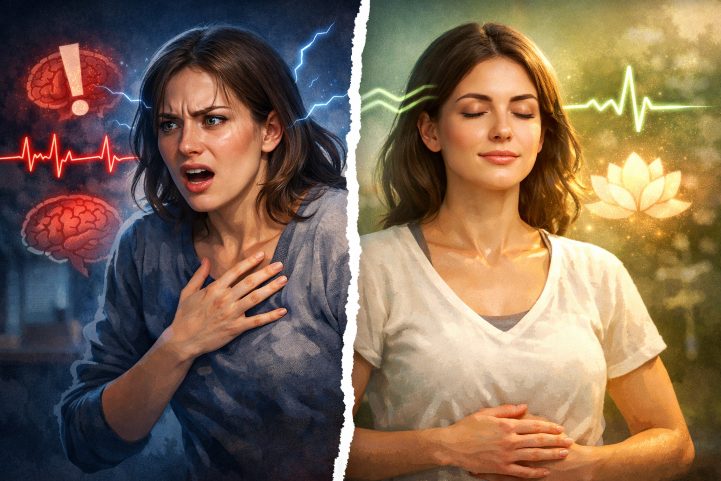
Hyperventilation and deep breathing are often confused, yet they have very different effects on the body and mind. Hyperventilation involves breathing faster or deeper than the body needs, disrupting carbon dioxide balance and often increasing anxiety. Healthy deep breathing, when practiced with awareness and rhythm, supports nervous system regulation, emotional balance, and mental clarity. Understanding the difference helps explain why some breathing habits heighten stress while others restore calm.
Breathing is one of the few bodily functions that happens automatically, yet can also be consciously influenced. Because we can feel our breath so clearly, it’s easy to assume that breathing more—taking bigger or faster breaths—must be better. This assumption, however, is one of the most common misunderstandings about respiration.
In everyday conversation, people often equate breathing with oxygen intake. If we feel anxious, lightheaded, or short of breath, the instinct is to inhale more deeply or more frequently. Yet the respiratory system is not designed simply to maximize oxygen. Instead, it maintains a delicate balance between oxygen and carbon dioxide that supports blood chemistry, brain function, and nervous system signaling.
Modern lifestyles add another layer of complexity. Chronic stress, long hours of screen time, shallow chest breathing, and constant mental stimulation subtly change how we breathe. Over time, many people develop inefficient or dysregulated breathing habits—without realizing it. Hyperventilation, a form of overbreathing, occurs when breathing becomes excessive, rapid, or deep, often leading to symptoms such as breathlessness and low carbon dioxide levels.
Understanding the difference between hyperventilation and healthy deep breathing begins with letting go of the idea that “more air” automatically equals better breathing.
The normal breathing pattern is gentle, silent diaphragmatic breathing with minimal upper chest movement, occurring at approximately 10-12 breaths per minute at rest.
Hyperventilation is defined as breathing faster or deeper than the body’s metabolic needs require (also called overbreathing). It doesn’t necessarily mean dramatic panting or obvious gasping. In fact, hyperventilation often manifests as subtle, habitual overbreathing.
A person can hyperventilate while sitting at a desk, lying in bed, or even during casual conversation. The key issue is not effort, but imbalance. When breathing exceeds the body’s needs, carbon dioxide levels drop too low, triggering a cascade of physiological effects.
Hyperventilation can also be used deliberately in specific high-performance or medical contexts.
Hyperventilation can occur during a panic attack.
Importantly, hyperventilation can become a learned pattern. Once the nervous system associates faster breathing with alertness or safety, it may default to that pattern even when no real threat is present.
To understand why hyperventilation can feel so uncomfortable, it helps to look at what’s happening inside the body. When you hyperventilate, you breathe faster and deeper than your body needs, causing you to exhale more carbon dioxide than usual. This drop in blood carbon dioxide leads to a condition called respiratory alkalosis, in which the blood becomes more alkaline than normal.
Carbon dioxide (CO₂) is often misunderstood as something the body simply needs to get rid of. In reality, CO₂ plays a critical role in regulating blood pH and enabling oxygen to be released from hemoglobin into tissues—a phenomenon known as the Bohr effect.
When CO₂ levels drop too low due to hyperventilation:
This explains why hyperventilation can paradoxically cause sensations of air hunger, dizziness, or mental fog—even though blood oxygen levels are technically adequate.
Low CO₂ levels also influence the autonomic nervous system. Hyperventilation tends to activate the sympathetic “fight or flight” response, increasing alertness, muscle tension, and emotional reactivity. Over time, this can reinforce cycles of anxiety and stress sensitivity.
Symptoms of hyperventilation can vary from person to person, but commonly include:
Other symptoms may also occur, such as dizziness, shortness of breath, and numbness and tingling in your arms or around your mouth.
These sensations can be alarming, especially when they appear suddenly. Because they overlap with symptoms of anxiety and panic attacks, many people assume something is wrong with their lungs or heart, which can further escalate stress.
Feeling anxious or short of breath isn’t always about stress—it can be about how you’re breathing. Guided breath practices offer a structured way to support nervous system regulation and restore balance. Learn how rhythmic breathing can help you feel calmer and more centered in daily life.
Deep breathing is often recommended as a solution to stress, but the phrase itself can be misleading. Not all deep breathing is beneficial, and not all beneficial breathing feels dramatic or forceful.
Healthy deep breathing involves:
In contrast to hyperventilation, deep breathing is not about taking in as much air as possible. It’s about breathing efficiently and comfortably, in a way that supports the body’s natural rhythms.
Diaphragmatic breathing allows the lungs to expand fully without excessive effort. Chest breathing, which lifts the shoulders and upper rib cage, primarily involves the chest wall and is more commonly associated with stress and hyperarousal.
That said, diaphragmatic breathing alone is not a guarantee of regulation. Speed, rhythm, and awareness all matter just as much as depth.
Breathing exercises can help you relax and breathe from your diaphragm and abdomen, rather than your chest wall.
When breathing is slow, rhythmic, and balanced, it sends powerful signals to the nervous system.
Healthy deep breathing supports the parasympathetic branch of the autonomic nervous system, often described as the “rest and digest” response. This state is associated with:
Regulated breathing patterns are linked to improved heart rate variability (HRV), a marker of the nervous system’s ability to adapt to stress. Higher HRV is associated with greater emotional resilience and overall well-being.
Rather than suppressing stress, healthy breathing helps the body move smoothly between states of activation and rest.
Although hyperventilation and deep breathing can look similar on the surface, their effects are very different.
During a panic attack, taking deep, quick breaths can actually worsen symptoms by depleting CO₂. Focusing on slow exhalations or using pursed-lip breathing can help restore gas balance during a panic attack.
Understanding these differences helps explain why some people feel worse when they are told to “just take a deep breath.”
AspectHyperventilationHealthy deep breathingBreathing speedFast, irregular, or excessiveSlow, steady, and rhythmicBreath depthOften over-deep or forcedComfortable, natural depthCarbon dioxide levelsDrops too lowMaintained in healthy balanceOxygen deliveryReduced delivery to tissues (Bohr effect)Improved oxygen utilizationNervous system responseActivates stress (fight-or-flight)Supports relaxation and regulationCommon sensationsDizziness, tingling, chest tightness, panicEase, calm alertness, clarity