



Artificial intelligence is everywhere.
It's helping millions write emails, plan vacations, summarize books, generate recipes, answer questions of all kinds, and help people tackle everything from homework to home repairs. Chances are, you've already used it yourself, or you've thought about it.
I know I have.
As a writer, editor, content creator, presenter, chef, and party planner, I've spent countless hours exploring what AI can do. Sometimes it amazes me how it can be a collaborator, not just an assistant. It can certainly organize complex information in seconds and explain difficult concepts clearly. But it can also help overcome the occasional bout of writer's block. I have even used it as a Jyotish astrologer.
AI is a remarkable tool. But like any powerful tool, how we use it matters.
Possibly the most important question we can ask is, can we use it without slowly handing over the very qualities that make us human? Let’s take a closer look at how to use AI and not lose yourself in the process.
One of AI's greatest strengths is also one of its greatest temptations. It gives answers, fast and confidently. Often in a tone that sounds remarkably convincing.
That doesn't mean it's always right. Nor does it mean it's right for you. AI is trained on enormous amounts of information. Some of that information is excellent. Some of it isn't. That's why discernment matters.
Rather than hand over our intellects to AI, we need to engage our intellect. Consider AI as just one perspective. Just like with human beings, there’s always more to consider when having an opinion.
AI can help us to form ideas; what it can't do is know your life.
It doesn't know what you've lived through. It doesn't understand your relationships, your intuition, your values, or the quiet wisdom you've gained from years of experience.
Those things only belong to you.

One of our greatest strengths is discernment, the ability to recognize nuance and hold multiple possibilities. Humans can recognize that much of life rarely exists in black and white. We navigate the gray. Human intelligence recognizes that life is rarely as simple as a single answer.
When AI offers a response, treat it as the beginning of a conversation, not the end of one.
Ask yourself:
One experience I’d like to share is when I used AI for Jyotish astrology, which taught me an important lesson. The first birth chart generated sounded amazing, but I could tell it just wasn’t me. I asked AI to check its calculations. I watched as the AI chatbot took its time recalculating, and sure enough, it found the error.
Because of the year I was born, it had miscalculated daylight saving time for my location. Once corrected, the chart aligned with the one I'd previously received from an experienced human Jyotish astrologer. The point is that AI can make mistakes, and we need to use our discerning skills while using it. We need to verify the validity of AI responses.
I really love using AI to explore ideas. It helps me see different perspectives. It introduces connections I may not have considered. And I love how it can explain complicated subjects in surprisingly accessible ways. But after that, something important still has to happen.
I have to think. I have to reflect. I have to decide what resonates and what doesn't. That's the part no technology can do for me.
The goal shouldn’t be to let Artificial Intelligence think instead of us. It's to let it help us think better.
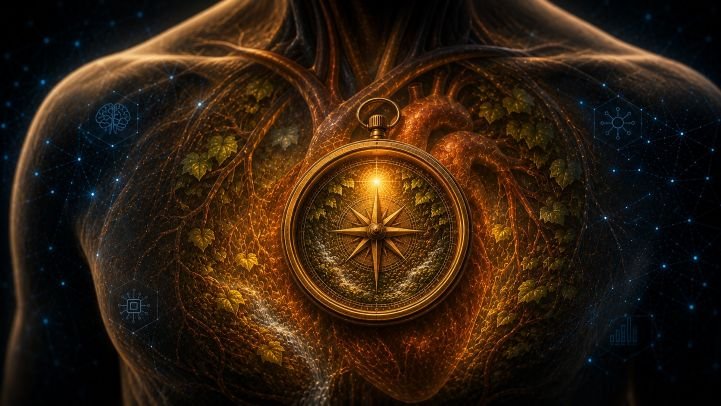
We live in a world overflowing with information, and it’s more accessible than any other time in history. The challenge is no longer finding answers. The challenge is knowing which answers deserve our attention, and which resonate with our inner compass. That's one reason meditation has never been more valuable.
When the mind is constantly engaged, every confident AI answer can sound like truth. When the mind becomes calm, something shifts. We become more observant. We are more capable of noticing the difference between correct and incorrect answers, and even between information and wisdom.
Practices like meditation and conscious breathing can complement AI. These practices strengthen the very qualities that technology cannot replicate: awareness, presence, compassion, intuition, ethics, and inner clarity.
Technology's realm is information. Only human beings have access to wisdom.

As AI becomes part of daily life, a few simple habits can make a big difference. Before asking AI a question, pause for one conscious breath. Be clear about what you're really trying to understand. This goes beyond writing the perfect prompt. It begins with understanding what you're truly asking.
Read the response with curiosity rather than certainty. Be sure to verify important facts. Notice whether the answer merely sounds convincing or whether it genuinely withstands thoughtful reflection.
And every so often, put the technology aside altogether. Some questions aren't meant to be answered immediately. Some insights only arrive in silence. Pause in silence and let the question be a wonder before you check with AI for the upteenth time. Trust in your ability to access what Art of Living calls Absolute Intelligence.
There’s no doubt that artificial intelligence will continue to evolve. It will become faster, more capable, and more woven into our everyday lives.
The question isn't whether AI will change the world. It already has.
The real question is whether we'll continue developing the qualities that make us deeply human.
These qualities don't come from algorithms. They grow through experience, reflection, breathwork, and meditation.
Use AI. Learn from it. Let it inspire new ideas. Just don't forget that your greatest source of intelligence has never been outside you. It's the awareness you cultivate within.
Artificial intelligence is changing the world. The opportunity before us is to ensure it also inspires us to become more thoughtful, more discerning, and more deeply human.
Now you are better prepared on how to use AI without losing yourself.

There’s no better way to keep from losing yourself in this age of AI than through SKY Breath Meditation. And, there may be no better time to strengthen your connection to Absolute Intelligence, the quiet wisdom already within you. To do both, take the Art of Living Part 1 Course where you will learn a host to transformational tools including a home SkY practice.
Learn more about SKY and the the Part 1 Course here.
Absolute Intelligence vs Artificial Intelligence: What’s the Difference?
The Only Thing AI Can Never Replace