


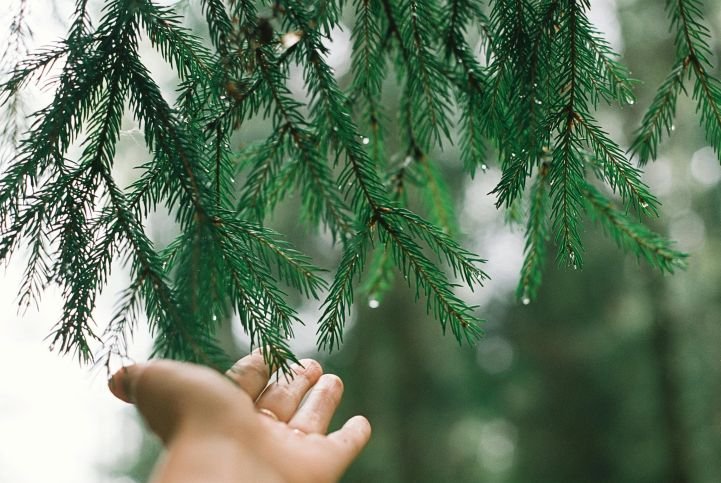
The concept of forest bathing has been around for more than 50 years, but it has recently gained popularity with a wider audience, largely because Western science is recognizing its real-world health benefits. Originating in Japan and known as Shinrin-yoku, forest bathing engages all five senses in an immersive nature experience.
Forest bathing doesn’t require you to remove any clothing, nor is it really ‘bathing’. The bathing aspect speaks to surrounding yourself with all the elements of a forest. So instead of bathing in water, you are bathing in the energy that is uniquely part of a forest.
Every sense- sight, smell, touch, hearing, and even taste- is central to the core practice of forest bathing. Through our eyes, we take in all the colors of the natural setting and wildlife. Our sense of smell might notice the damp earth, the wildflowers, or any number of aromas. Our hands, feet, and other parts of our bodies can experience the forest through touch. Through our ears, we hear the wind rustling through the trees, the crunch of leaves and sticks on the path, and a myriad of bird songs. The forest offers many flavors, sweet, tart, and bitter, in the form of berries and other edibles to taste. Note that these can also be dangerously poisonous, so caution and education are needed before delving into tasting the forest.
Let’s take a look at the benefits and how to practice.
The physical and mental health benefits of Shinrin-yoku are supported by growing scientific research. While more research is needed, here are some reported benefits, grouped into physical and mental health categories.
☐ A central mechanism behind forest bathing benefits is the inhalation of phytoncides, volatile organic compounds (VOCs) that trees release as a natural defense against pests and diseases.
☐ Forest bathing is theorized to enhance brain function through an oxygen-rich environment and the inhalation of therapeutic plant compounds.
☐ Forests contain higher levels of prana (vital life energy), and when accessed through deep breathing exercises, this energy can enhance immune function, improve sleep, and reduce anxiety. Increasing your prana levels also leads to a stronger spiritual connection with the forest.
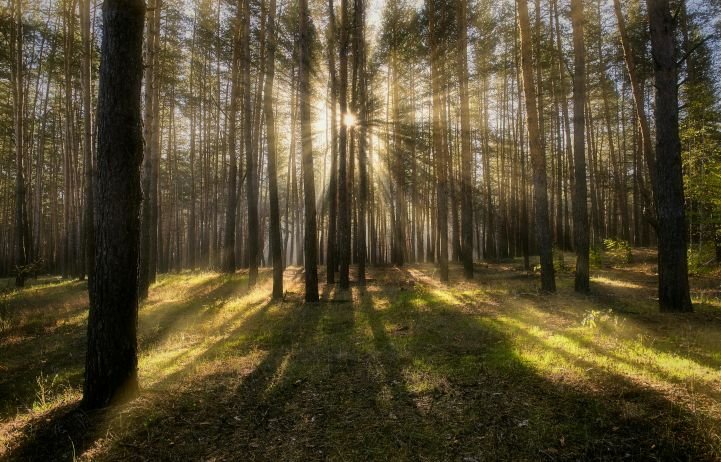
Forest bathing is less about “doing” and more about gently arriving in your senses. There’s no destination, no performance, and no need to get it “right.” Think of it as a slow, intentional relationship with nature. These instructions are for an ‘unguided’ practice.
You don’t need a deep forest to begin. A quiet park, a tree-lined trail, or even a garden can work.
Look for:
Tip: Leave your phone on silent or airplane mode to reduce distractions.
Before you begin walking, pause.
If you like, you can set a gentle intention like:
This isn’t about achieving calm; it’s about being present with what is.
Begin walking, but at about half your usual speed; even slower is better.
Let your body lead rather than your mind. There’s no need to cover distance. In fact, you might only walk a few hundred feet in 20 minutes. That’s how slow forest bathing’s pace functions best.
If it feels natural, occasionally pause completely.
Bring your attention to each sense. Let your awareness land softly, without forcing.
You’re not analyzing, just noticing.
If something naturally catches your interest: a tree, a rock, a patch of sunlight, pause there.
Spend a few moments simply being with it:
There’s no need to label or interpret the experience.
At some point, find a place to sit or stand still for a few minutes.
Let the environment come to you:
This is often where the most subtle shifts happen.
Before you leave, pause again.
You might ask yourself:
You can also express a quiet sense of gratitude for the space, to yourself, or simply to the moment. You may also want to journal following a forest bathing session.
As you return to your day, try to carry one thread of awareness with you, your breath, a sense of spaciousness, or a softened pace.
Forest bathing doesn’t have to end when you leave the trees. Observe its effects unfolding as you move through your day and evening.
You’ll want to spend at least 15-20 minutes, but 2-3 hours is the recommended ‘dose’. With that said, even a short, mindful visit can be meaningful. What matters more than duration is your level of presence.
As for frequency, recommendations range from once or twice a week to once or twice a month.
If you find yourself thinking that you are “doing it wrong,” that’s just the mind trying to take over. There’s nothing to fix. There’s really no wrong way to do forest bathing.
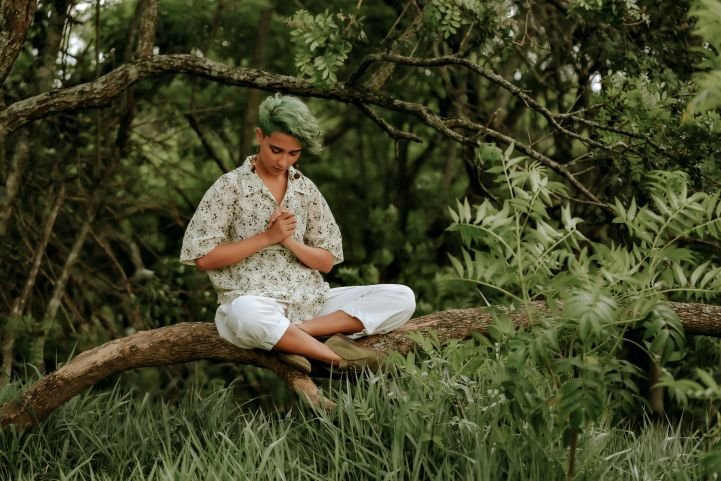
For a more curated, yet unguided, experience, use these prompts to invite presence without over-directing. Let them be gentle nudges rather than exact instructions.
☐ Notice the variety of greens around you. How many shades of green can you find?
☐ Let your eyes follow light as it moves through leaves or across the ground.
☐ Pause on something small you might normally overlook.
☐ Listen to all the sounds around you, gradually noticing the quieter ones.
☐ Check to see if you can hear your breath moving or your heart beating.
☐ Notice layers of sound. What’s the closest sound? What’s farther away?
☐ See if you can hear the spaces between sounds.
☐ Feel the texture of something natural: tree bark, a leaf, a stone.
☐ Notice the ground beneath your feet as you walk or stand.
☐ Become aware of the air on your skin, cool, warm, still, or moving.
☐ Gently notice any scents in the air, even if they’re faint.
☐ Move slightly and see if the scent changes.
☐ Let the experience be subtle—no need to search for anything strong.
☐ Become aware of how the air tastes.
☐ Ask yourself: What am I noticing right now?
☐ Follow that curiosity without needing to understand it.
☐ Let the experience unfold moment by moment.
☐ Walk at a pace that feels almost too slow.
☐ Pause whenever something catches your attention.
☐ Notice how your body naturally wants to move in this environment.
☐ Be open to Tai-Chi-like movements, swaying, and dancing.
☐ Find a place to sit or stand for a few moments.
☐ Notice what shifts when you become still.
Many people often start with unguided solo forest bathing, but for... [truncated]