


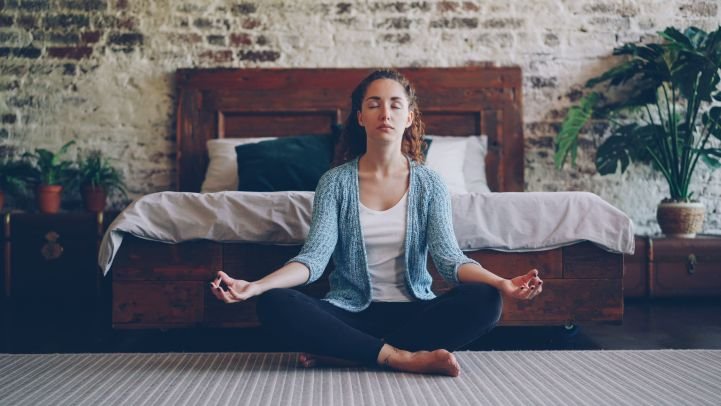
You're tired. Maybe you've been tired since mid-afternoon.
You finish everything that needs to be done, get ready for bed, turn out the light, and finally settle under the covers.
And suddenly, your brain is wide awake.
Did I answer that email? What time do I need to leave tomorrow? Why did I say that? I really need to deal with that thing I've been avoiding. And while we're at it, let's revisit something embarrassing that happened twelve years ago.
Sound familiar? The embarrassing thing twelve years ago is laughable, but it happens!
Being tired and being ready for sleep aren't necessarily the same thing. Your body may be exhausted while your nervous system is still operating as though there are things to do, problems to solve, or threats to watch for.
That's where your breath can help.
A simple evening breathing routine can help you make the transition from the activity of the day to the rest of the night. And when stress or anxiety is regularly interfering with sleep, working with the breath may offer something even more valuable: a way to address the state of your nervous system rather than simply trying harder to fall asleep.
You breathe all day without thinking about it. But your breathing also changes in response to what you're experiencing.
Think about what happens when you're startled, angry, anxious, or rushing to get somewhere. Your breathing may become faster, shallower, or less regular. When you're deeply relaxed, your breathing tends to slow down.
This connection works in both directions.
Your emotional and physiological state influences how you breathe, but intentionally changing the way you breathe can also influence how you feel.
Slow, comfortable breathing can help shift the autonomic nervous system away from heightened activation and toward the calmer state associated with rest and recovery. In particular, breathing practices that emphasize a slow, relaxed exhalation may support the body's natural relaxation response.
That doesn't mean you can breathe yourself unconscious on command.
Think of it differently: You're not forcing yourself to sleep. You're creating conditions that make it easier for sleep to happen.
And that starts before your head hits the pillow.

You don't need special equipment, complicated instructions, or a perfect meditation space. You don't even need to be in bed.
In fact, consider making this practice part of the transition to bed.
Before changing your breathing, change your environment.
Dim the lights. Put away work. Set your phone aside. Turn off the television. Sit somewhere comfortable or get into bed if you're ready to stay there.
Most importantly, give yourself permission to stop accomplishing things.
We often expect our bodies to transition instantly from stimulation to sleep. One minute we're answering messages, scrolling through social media, or watching television. The next, we're lying in the dark wondering why we aren't asleep.
Give yourself a few minutes of transition instead.
For the first minute or two, don't change anything.
Just breathe and observe.
Notice where you feel the breath most clearly. Is your breathing shallow or deep? Fast or slow? Do you feel movement primarily in your chest, belly, or ribs?
You don't need to decide whether you're breathing correctly.
You're simply noticing where you are before asking your body to go somewhere else.
Now begin slowing your breathing.
Take a comfortable breath in through your nose. Then allow the breath to leave a little more slowly.
Don't strain to take an enormous breath. And don't force yourself to exhale until your lungs feel completely empty.
Keep it easy.
Continue for about three to five minutes, allowing your exhalation to become slightly longer and more relaxed than your inhalation.
If counting helps you stay focused, you can use a comfortable rhythm in which the exhale is longer than the inhale. But the exact numbers matter less than keeping the breath slow, gentle, and relaxed.
If you feel light-headed or uncomfortable at any point, return to your normal breathing.
This may be the most important part.
After several minutes, stop trying to breathe a particular way.
Let your breath find its own rhythm.
Feel the air entering and leaving your body. Notice your chest or abdomen rising and falling.
And when a thought inevitably appears, because that's what minds do, you don't have to finish thinking it.
Return your attention to the next breath.
Then the next.
You're practicing something that can be surprisingly difficult at the end of a busy day:
Not doing anything. But the breath has the ability to gently help you transition from doing to doing nothing.
Stay here for another few minutes, or simply allow yourself to drift toward sleep.

A bedtime breathing routine can help, especially when occasional stress or overstimulation keeps you awake.
But what happens when sleeplessness isn't occasional?
Stress, anxiety, and sleep can become caught in a frustrating feedback loop.
You're stressed, so you don't sleep well.
Because you haven't slept well, you're tired and more sensitive to stress the next day.
That heightened stress makes it harder to relax the following night.
After a while, you may even begin worrying about sleep itself.
You look at the clock and calculate how many hours you have left.
If I fall asleep right now, I can still get six hours.
Twenty minutes later:
Now it's five hours and forty minutes.
Eventually, simply getting into bed can become associated with trying and failing to sleep.
And trying harder to sleep doesn’t really help.
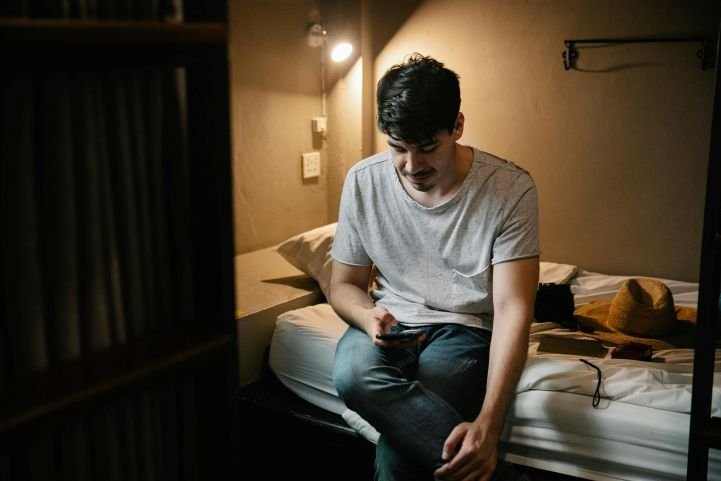
Anxiety doesn't always announce itself as a panic attack or an obvious feeling of fear.
At bedtime, it might look more like:
In other words, the problem may not begin when you get into bed.
Bedtime may simply be when you finally become quiet enough to notice what's been happening inside you all day.
That's why a breathing technique at bedtime can be useful without necessarily being the whole solution.
Sometimes it's worth working with the larger pattern.

If stress or anxiety regularly follows you into bed, Art of Living's Sleep & Anxiety Protocol offers a more comprehensive approach.
Rather than focusing exclusively on what happens during the few minutes before sleep, the protocol provides practices and tools designed specifically to help you work with sleep difficulties and anxiety.
This distinction matters.
An evening breathing routine can help you manage tonight's activation.
The Sleep & Anxiety Protocol can help you work more intentionally with the larger patterns of stress and anxiety that may be affecting your sleep.
Instead of asking only, How do I make myself sleep tonight?, you can begin asking a different question:
What can I do during the day and before bed to make it easier for my body and mind to let go at night?
Explore the Sleep & Anxiety Protocol →

There are signals all around you throughout the day.
Your alarm tells you to get up.
Notifications tell you to look at your phone.
Emails tell you someone needs something.
A calendar alert tells you where you're supposed to be next.
Maybe your evening breathing practice can become a different kind of signal.
Dim the lights.
Put away the day.
Get comfortable.
Notice your breath.
Slowly lengthen the exhale.
Then stop trying.
With repetition, this small ritual can begin to mark the boundary between doing and resting.
You don't have to solve tomorrow tonight.
You don't have to force your mind to become completely quiet.
And you don't have to force yourself to sleep.
For these few minutes, there is nothing more you need to do.
Just breathe.
And let the day end.