



Coffee, matcha, and breathwork all influence energy, focus, and calm by affecting the nervous system. Coffee and matcha stimulate alertness through caffeine, whereas breathwork supports regulation by calming stress responses and restoring mental bandwidth. Understanding the difference between stimulation and regulation helps explain why sustainable energy comes from balance, not constant boosts.
Energy has become one of the most sought-after resources of modern life. Many of us wake up already feeling behind—behind on sleep, behind on work, behind on emotional bandwidth. Before the day has fully begun, we are reaching for something to help us feel awake, alert, and capable.
For millions of people, that “something” is coffee. For others, it is matcha, green tea, or another caffeinated ritual that promises a gentler boost. And increasingly, people are exploring breathwork—not as a spiritual abstraction, but as a practical way to feel more focused, calm, and resilient.
At first glance, these three things may seem unrelated. Coffee and matcha are beverages. Breathwork is a practice. One comes in a mug, another in a bowl, and the third requires nothing at all.
Yet they all have something important in common.
They all influence the nervous system—and through it, our experience of energy, clarity, stress, and emotional balance.
Understanding how they work and how they differ allows us to make more intentional choices about how we support ourselves throughout the day.
We often think of energy as a personality trait or a physical resource. Some people are “high energy.” Others are not. Some days we have it; some days we do not.
However, from a physiological perspective, energy is largely a state of the nervous system.
Your nervous system continuously interprets signals from your environment and your body. Is this moment safe or demanding? Calm or urgent? Predictable or uncertain? Based on those signals, it adjusts:
Coffee, matcha, and breathwork all affect these systems. They all influence how alert or calm you feel, how clearly you think, and how much capacity you have to meet the moment.
The key difference is how they do it.
Coffee is one of the most widely used psychoactive substances in the world, and for good reason—it works. At least in the short term.
Caffeine primarily works by blocking adenosine, a neurotransmitter that signals fatigue. As adenosine builds up during the day, it increases sleep pressure. When caffeine blocks adenosine receptors, the brain temporarily stops receiving the message that it is tired.
At the same time, caffeine increases the release of neurotransmitters such as dopamine and norepinephrine and activates the stress response. Cortisol and adrenaline rise, heart rate increases slightly, and the brain shifts into a more alert, vigilant state.
In simple terms: coffee doesn’t create energy—it masks fatigue and stimulates alertness.
For many people, coffee also has a strong emotional component. It marks the beginning of the day, offers warmth and familiarity, and provides a moment of pause before responsibilities begin.
While coffee can be beneficial, especially in moderation, it remains a stimulant. Over time, frequent stimulation can come with trade-offs:
These effects are not signs of personal weakness. They are signals from the nervous system that it is being repeatedly asked to remain in a heightened state for too long.
Matcha has gained popularity as an alternative to coffee, often described as providing “calm energy” rather than a jolt. This reputation is not just marketing—it reflects real differences in how matcha affects the nervous system.
Matcha is a powdered form of green tea, meaning you consume the whole leaf rather than steeping and discarding it. This results in a unique combination of compounds, most notably caffeine and L-theanine.
L-theanine is an amino acid known to promote relaxation and support alpha brain wave activity, which is associated with calm focus.
Because of this combination, matcha tends to:
Many people find matcha easier on their nervous system, especially if they are sensitive to caffeine or prone to anxiety.
It is important to note that matcha is still a stimulant. It still activates the nervous system and influences cortisol levels. The difference is not whether it stimulates, but how intensely and how evenly.
For some people, this makes matcha a better choice. For others, especially those already under chronic stress, even gentle stimulation can add to nervous system load.
Breathwork occupies a completely different category. Unlike coffee or matcha, it does not introduce any external substance into the body. Instead, it works directly with a system you are already using all the time—your breath.
Breathing is unique in that it is both automatic and voluntary. You do not have to think about breathing, yet you can consciously change how you breathe at any moment.
This provides the respiratory system with a direct pathway to the nervous system.
Breathing patterns influence:
Through breath, you can send signals of safety or urgency to the brain within minutes.
One of the most important distinctions to understand is that breathwork does not “boost” energy in the way caffeine does.
Instead, it removes obstacles to the energy you already have.
Chronic stress, shallow breathing, and nervous system dysregulation consume enormous amounts of mental and physical resources. When the nervous system is stuck in a low-grade fight-or-flight state, energy is diverted toward vigilance rather than clarity.
Regulated breathing helps shift the system out of this state, freeing up attention, focus, and emotional steadiness.
Read The Nose Knows: Biohacking Energy Flow Through the Nostrils to learn more.
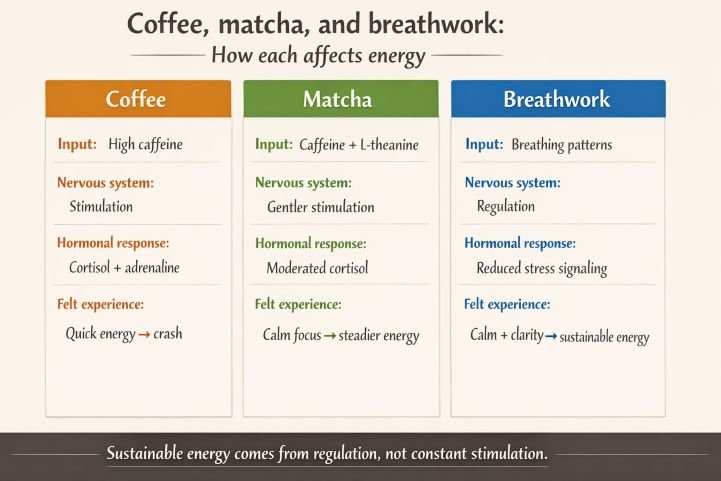
Understanding the difference between stimulation and regulation helps explain why so many people feel exhausted despite relying on caffeine.
Coffee and matcha ask the nervous system to perform at a higher level. They push alertness upward, regardless of the system’s underlying state.
This can be helpful in short bursts. It can also be costly if used as the primary means of managing energy.
Breathwork improves the efficiency with which the nervous system functions. It reduces unnecessary stress signaling and helps the body return to balance more easily.
When the nervous system is regulated:
This is why people often report feeling both calmer and more energized after breathwork—two states that are not opposites, but partners.
Curious how breath can create calm, focused energy—without the crash?
Breath-based practices work directly with the nervous system, helping restore balance, clarity, and resilience from the inside out.
Explore breath-based practices
Both caffeine and breathwork can increase alertness, which is why they are sometimes grouped together as “energy tools.” But the similarity is superficial.
Caffeine works by overriding fatigue signals. Breathwork works by addressing the causes of fatigue—stress, tension, shallow breathing, and nervous system overload.
This distinction matters because one approach can be used repeatedly without incurring long-term costs, whereas the other requires recovery.
A useful way to think about energy is through the concept of mental bandwidth. Mental bandwidth refers to the brain’s capacity to process information, make decisions, and regulate emotions.
Chronic stress narrows this bandwidth. Even simple tasks feel overwhelming. Focus becomes fragmented. Decision-making becomes harder.
Stimulants can temporarily stretch bandwidth by increasing alertness, but they do not address the underlying constriction.
Breathwork helps widen bandwidth by calming the nervous system and reducing background stress noise. This creates the experience of having more energy—not because anything was added, but because less is being drained.
A regulated approach to energy does not require eliminating caffeine. Coffee and matcha can absolutely have a place in a balanced life.
They can be supportive when: