



Are your emotions having a ‘monkey swinging’ from the trees moment? Or, maybe your emotions are taking you for a roller coaster ride? One thing is for sure: the need of the times is for more emotional balance. Parents are feeling it. Business owners are feeling it. Students and professors are feeling it. Regular Joes, Janes, and just about everyone are all feeling it.
There are bigger demands and less time, more information to consume and digest, budgets to manage, new technologies to learn, and, let’s not forget, interpersonal relationships to navigate—and all of these come with their own complex emotions. Is it any wonder that we need easy-to-use tools for regaining our emotional balance?
No worries, we are here to share practical techniques and daily routine tips you can use to regain the emotional balance you are missing. Breathwork for emotional balance not only helps with stress management and relaxation, but also supports anxiety reduction, enhances cognitive performance, and can be especially beneficial for individuals with attention deficit disorder by improving focus and emotional regulation.
We’ll start with how breathwork helps this need in the first place, and after that, we will share an assortment of breathing exercises you can keep in your back pocket for whenever you need them. Keep reading to learn all of this and more! Breathing exercises can lower heart rate, reduce stress hormones, and calm the mind.
Breathwork is the intentional practice of controlling and becoming aware of your breath to support your physical, emotional, and mental well-being. At its core, breathwork uses deep breathing and a variety of breathing exercises to help you tap into the power of your own breath. By focusing on how you breathe, you can directly influence your nervous system, making it easier to reduce stress, manage anxiety, and maintain emotional balance, even in the midst of daily life’s challenges.
The purpose of breathwork is to give you a powerful tool for self-regulation. Deep breathing techniques, such as diaphragmatic breathing, activate the parasympathetic nervous system, the branch responsible for promoting relaxation and counteracting the fight-or-flight response. When you inhale deeply and exhale slowly, you send signals to your body that it’s safe to relax, which helps lower stress hormones and supports your mental health and overall mental well-being.
Incorporating breathing techniques into your daily routine can help you manage anxiety, reduce stress, and maintain emotional balance. Whether you’re facing a stressful meeting, a tough parenting moment, or just need a reset, breathwork offers a simple, accessible way to regain control and restore calm. Over time, consistent practice can help you build resilience, improve your mood, and enhance your ability to handle whatever life throws your way.

Basically, deep breathing increases lung volume, stimulating pulmonary baroreceptors and sending signals to the brain that promote relaxation. But there’s more to deep breathing than just sending a cue to relax.
There is an inherent connection between breathing and the autonomic nervous system. Breathing serves as a direct, voluntary bridge for controlling the autonomic nervous system (ANS), affecting both its sympathetic ("fight-or-flight") and parasympathetic ("rest-and-digest") branches. Slow, deep breaths activate the vagus nerve, reducing heart rate and stress, while fast or shallow breathing triggers stress responses, highlighting a two-way connection.
This Harvard Business Review article shares research findings on why breathing is so effective at reducing stress. The authors explored the effectiveness of different techniques and found that one method, SKY Breath Meditation (Sudarshan Kriya), offered the best results for both immediate and long-term stress reduction.
Another study, featured in YaleNews, tested specific techniques known to reduce stress and improve mental health. Interestingly, SKY significantly outperformed one of the better-known techniques, Mindfulness-Based Stress Reduction (MBSR), highlighting the power of your breath in building emotional resilience.
Breathing and the vagus nerve are in constant conversation. This two-way communication shapes how quickly your body responds to stress, how deeply you rest, and how effectively you return to calm. This interaction directly influences the stress response, supporting recovery and the return to emotional balance.
One reason breathing exercises are helpful for emotional balance is the breath focus cues. Breath focus cues are gentle anchors that guide attention back to the present moment through the rhythm of breathing.
Simple guided phrases like “inhale, soften” and “exhale, release” help calm the nervous system, while more specific cues, such as noticing the coolness of the inhale at the nostrils or the rise and fall of the belly, bring awareness into the body, adding a somatic element to breathwork.
Counting breaths, extending the exhale, or silently repeating a word or mantra can further steady the mind. Rather than forcing the breath, these cues invite a natural, relaxed awareness, allowing the breath to gradually slow, deepen, and feel more easeful on its own.
Between specific breath-focus cues and how the breath is used (slower, longer, or with control), breathwork offers real-time relief and the ability to shift toward a more balanced state of mind and emotions.
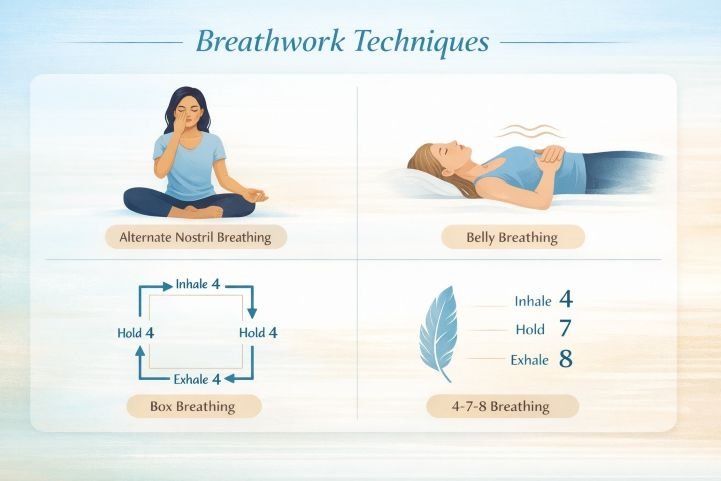
In this section, we will explore alternate nostril breathing, belly breathing, box breathing, 4-7-8 breathing, and SKY Breath Meditation. We’ll identify which techniques work for various situations, as well as any contraindications.
How to practice:
How long to practice:
This breathwork can be practiced for as little as a few minutes or as long as ten minutes.
What to expect:
This technique calms quickly, balances the brain hemispheres for better focus, and is ideal to use before meditating. In many respects, alternate nostril breathing is a multi-tasking technique.
Contraindications:
No major contraindications, though it may be difficult to practice if you are congested. Obviously, avoid if you have had recent nasal surgery.
How to practice:
How long to practice:
Diaphragmatic breathing is most effective when practiced regularly for 10 to 15 minutes.
What to expect:
Because of the somatic nature of this technique, you may experience deeper relaxation during the practice and be calmer in your daily life. Diaphragmatic breathing enhances parasympathetic activation and fosters emotional regulation.
Contraindications:
Consult a healthcare professional if you have any concerns.
How to practice:
This breathing exercise is easier than diaphragmatic breathing or 4-7-8 (listed below). Simply breathe in, hold, exhale, and hold your breath in equal proportions, creating a box pattern, 4-4-4-4, or 6-6-6-6.
How long to practice:
You can practice this breathwork as little as a minute or two, and as long as ten minutes.
What to expect:
Box breathing is a technique that enhances focus and emotional control by using a structured breathing pattern. It helps you maintain focus and composure in stressful situations, making it useful for stress management and focus enhancement. Box breathing can be used for arousal control in acute situations.
Contraindications:
There are no major contraindications.
How to practice:
Step 1: Find a quiet space, sit with your back straight, or lie down on a flat surface.
Step 2: Inhale for 4 seconds. Your lungs should fill completely until your stomach expands like a balloon.
Step 3: Hold for 7 seconds.
Step 4: Exhale for 8 seconds. Let all the air out through your mouth with pursed lips.
How long to... [truncated]