


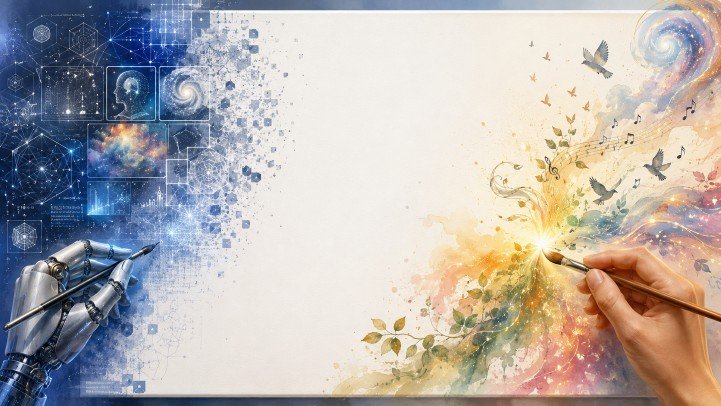
This article was inspired by an interview with Gurudev Sri Sri Ravi Shankar at Deakin University's Applied Artificial Intelligence Institute, exploring Absolute Intelligence vs. Artificial Intelligence and how we as humans can thrive in the age of AI. It is the first installment in the three-part series, Being Human in the Age of AI, exploring consciousness, connection, and the calm mind in an era of increasingly intelligent machines.
It writes essays, creates artwork, summarizes research, and answers questions in seconds. Every week brings another breakthrough, leaving many to wonder whether AI will eventually surpass human intelligence.
But perhaps we're asking the wrong question.
Instead of asking how intelligent artificial intelligence will become, Gurudev Sri Sri Ravi Shankar invites us to ask something even more important:
How are we developing our own intelligence?
Today, we often equate intelligence with speed, memory, and problem-solving. AI excels in these areas, which makes it tempting to define intelligence by what machines do well.
But human intelligence has always been multidimensional.
It includes creativity, intuition, empathy, moral reasoning, self-awareness, humor, imagination, and the ability to find meaning in experience. We don't simply process information; we transform it into wisdom through lived experience.
That's the distinction Gurudev invites us to explore.
Like all tools, AI has limitations. Depending on how and when it was trained or whether it has access to current information, it may overlook recent developments, lack important context, or confidently present incomplete conclusions.
Gurudev points to this one essential difference.
"AI can only reproduce what is already stored. It can't create something new. Human intelligence has the capacity to create something new."
This isn't simply a comparison between humans and machines. It's an invitation to cultivate the qualities that make us uniquely human: creativity, intuition, compassion, wisdom, and consciousness.

Modern science continues to investigate the nature of consciousness. Increasingly, researchers are exploring ideas once considered the exclusive territory of philosophy and spirituality.
Long before these conversations entered mainstream science, ancient wisdom traditions spoke of an intelligence woven throughout creation.
Gurudev describes this as Absolute Intelligence, the organizing intelligence present throughout nature and the universe.
Children naturally sense this.
When we were children, the trees talked to us.
Animals conversed with us.
The moon smiled at us.
Everything felt connected.
As adults, we often replace wonder with analysis. But perhaps the universe has been alive all along.
Have you noticed that since AI became part of daily life, many of us spend more time asking questions than sitting with them?
Never in history has humanity had more information available at its fingertips. Yet information alone doesn't create wisdom.
When asked what it means to possess "right understanding," Gurudev replied:
"An intellect free from prejudice, a mind that has clarity of perception, and an expression that is flawless."
Knowledge can fill the mind. Wisdom transforms the person. Perhaps wisdom is one of the clearest expressions of Absolute Intelligence in daily life.
Artificial intelligence can organize information. Only human intelligence can embody wisdom.
Today's conversations about AI often focus on capability. Gurudev shifts the discussion toward responsibility.
Ethics begins with the simple principle:
Don't do to others what you wouldn't want done to yourself. Gurudev's words echo what many traditions call the Golden Rule:
"Do unto others as you would have them do unto you."
The backbone of ethics is trust. Whether we are using artificial intelligence, social media, or any other technology, trust remains the foundation of healthy societies.
Gurudev shared:
“We are exposed to every kind of news- real news, fake news, and everything in between. Today, we have learned that we need to verify what we see. We fact-check before believing it.”
Disseminating information requires ethical practices, and the receiver must also have an intellect free from prejudice.
Technology itself is neutral. How we choose to use technology is not neutral. Ethical choices matter

If Absolute Intelligence permeates all of creation, why don't we experience it all the time?
According to Gurudev, the obstacle isn't a lack of intelligence; it's a mind clouded by stress, distraction, and constant mental activity.
Imagine standing beside a still lake. When the water is calm, it reflects the sky with remarkable clarity. But when the surface is disturbed, the reflection becomes fragmented and distorted.
Our minds work the same way.
Stress, anxiety, emotional overload, and the endless stream of information competing for our attention create mental turbulence. In that state, it's difficult to access our deepest creativity, intuition, or clarity. We react instead of respond. We become consumed by thoughts instead of seeing beyond them.
Breathwork and meditation offer a different possibility.
Modern life constantly pulls our attention outward toward notifications, deadlines, opinions, and endless streams of information. Breathwork reverses that movement. It gently turns awareness inward, allowing the mind to settle and the nervous system to recover from chronic stimulation. In that stillness, many people discover not new knowledge, but a deeper way of knowing.
In the yogic tradition, the breath is more than a biological function; it is the bridge between the body, the mind, and consciousness itself. Every emotion has a corresponding rhythm of breath. By consciously changing the breath, we can begin to change our state of mind.
As the nervous system settles, mental chatter begins to quiet. Perception becomes clearer. Intuition grows stronger. Decisions arise from greater awareness instead of habitual reactions.
This is one reason Gurudev has spent more than four decades teaching breathing techniques and meditation around the world.
Practices such as SKY Breath Meditation combine powerful rhythmic breathing and deep meditation to help release accumulated stress and restore inner balance. Research has shown that these practices can reduce stress, improve emotional well-being, enhance mental clarity, and support resilience. But beyond the measurable benefits lies something more subtle.
Many practitioners describe feeling more connected to themselves, to others, and to life itself.
Perhaps that is what Gurudev means by absolute intelligence.
Not something we invent.
Not something we download.
Something we uncover when the mind becomes quiet enough to recognize the intelligence that has always been there.
Artificial intelligence can process extraordinary amounts of information.
A calm mind can perceive extraordinary depths of wisdom.
The future will almost certainly include both. But only one begins within.
Artificial intelligence will undoubtedly continue to evolve and impact our lives in new ways, no question about it! The more important question is whether our own awareness evolves alongside it.
The future may be shaped by artificial intelligence.
But it will always be guided by the quality of human consciousness.
Artificial intelligence will continue to evolve. It will become faster, more capable, and increasingly integrated into our daily lives.
The discussion of Absolute Intelligence vs. Artificial Intelligence isn't about choosing one over the other. Our greatest opportunity is not to compete with AI, but to cultivate the qualities that make us fully human.
Each day, ask yourself:
These questions help shift our attention from external intelligence to inner intelligence.
As Gurudev reminds us, true intelligence isn't measured by how much we know, but by the clarity, creativity, and compassion with which we live.

If Absolute Intelligence is already present within us, how do we experience it?
According to Gurudev, the answer isn't found in accumulating more information. It's found in quieting the mind.
When the mind becomes calm, perception becomes clearer. Intuition grows stronger. Creativity flows more naturally. We begin responding to life with greater wisdom rather than simply reacting out of habit or stress.
This is why meditation has been central to wisdom traditions for thousands of years.
Practices such as SKY Breath Meditation help reduce stress, increase mental clarity, and reconnect us with the deeper intelligence that already exists within us. Rather than adding something new, meditation helps remove the mental noise that often prevents us from recognizing what has always been there.
Artificial intelligence can answer countless questions.
Meditation helps us discover the one asking them.
If you're curious about experiencing greater clarity, resilience, and inner peace, learn more about SKY Breath Meditation and discover how simple breathing techniques can help unlock your own highest potential.
************************************************
In our next article, we'll explore why AI may simulate companionship, but genuine human connection and freedom from loneliness... [truncated]